

Who We Are
We are a coalition of Pennsylvania parents, caregivers, and community members concerned about the unchecked expansion of screen-based technology into daily life.
We are working to restore real-world connection by advocating for policies and cultural norms that prioritize people over technology.

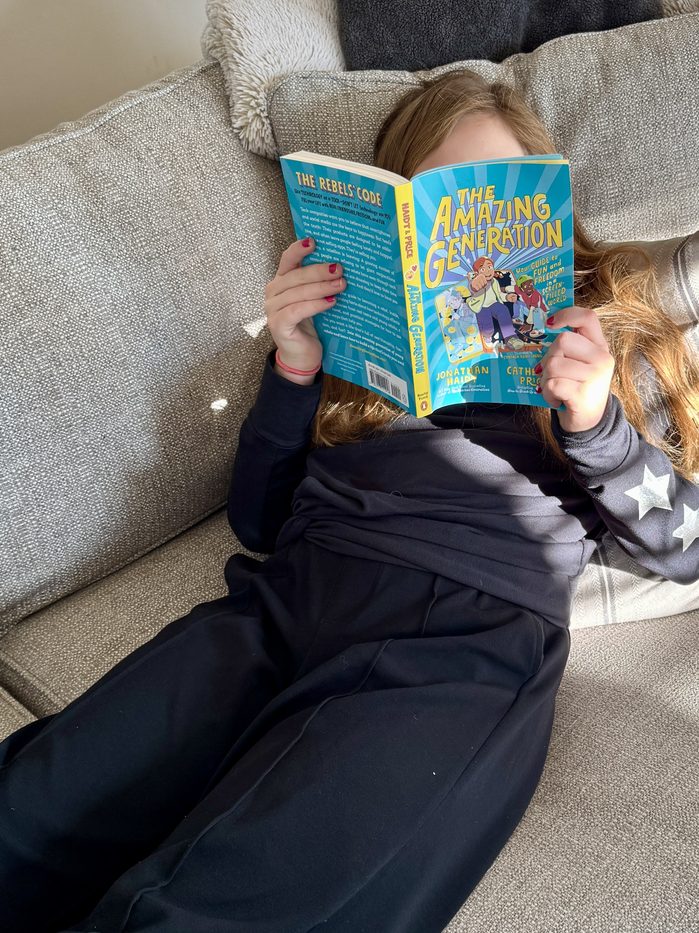
We are not anti-technology.
When used with intention and purpose, we believe tech can be a powerful tool. But too often, our devices sap our attention and crowd out connection and creativity.
While technology continues to advance faster than society can adapt, collective action remains our greatest tool for change.
The Research
The evidence is clear. We need to act now.
Pennsylvania data · 267,379 students
What Pennsylvania students are telling us
Every two years, Pennsylvania surveys students in grades 6, 8, 10 and 12 through the Pennsylvania Youth Survey. In 2025 it asked for the first time about recreational screen time, meaning hours on a phone, tablet, computer or TV for anything that is not schoolwork, alongside long-standing questions on sleep and mental health.
Pennsylvania middle schoolers spend 5 or more hours a day on recreational screen time, on a normal school day
Pennsylvania middle schoolers who spend 5 or more hours a day on recreational screen time felt sad or hopeless for two weeks or more in the past year
to have considered suicide or harmed themselves: middle schoolers at 5 or more hours a day of recreational screen time, compared with an hour or less
As recreational screen time rises, so does the share of students struggling
Pick an outcome — each point is a group of Pennsylvania students, grouped by the amount of daily recreational screen time. Hover over each point for exact numbers.
Among Pennsylvania middle school students with an hour or less of recreational screen time a day, 18.2% felt so sad or hopeless almost every day for two weeks or more that they stopped doing usual activities. Among those with 5 or more hours a day, the share rises to 38.3%, about twice as many.
When screen-time rules are enforced, the picture looks different
Both figures below compare Pennsylvania middle schoolers whose parents never enforce screen-time rules with those whose parents always do. The first figure includes the four measures from the chart above.
Fewer struggles
enforced
enforced
More connection and safety
enforced
enforced
Only 1 in 5 Pennsylvania middle schoolers say their parents always enforce screen-time rules. By high school it is 1 in 14.
How to read this
All four measures move the same direction, in middle school and in high school. That consistency is what you would expect if rules at home help. It is not proof: families who set rules may differ in other ways this survey does not measure.
Source: Pennsylvania Youth Survey (PAYS) 2025, via the PAYS Web Tool. Recreational screen time is question G5: “On a normal school day, how many hours in total do you use an electronic device such as a phone, tablet, computer, or TV, for something that is not schoolwork?” A normal school day means a typical weekday during the school year, not a weekend or holiday, and the hours cover the whole day rather than time spent at school. Middle school combines grades 6 and 8; high school combines grades 10 and 12. Students answer the survey once, at a single point in time, so it can show that screen time and these outcomes are related but not that one causes the other.
Where We're Working
The issues
Slow Tech Your Life
Five steps to take back your family's time, attention, and connection.
Learn more →Phone-Free Schools
Our teachers and students deserve distraction-free schools.
Learn more →EdTech
More technology in the classroom isn't necessarily better.
Learn more →AI & Your Family
Many parents don't realize their kids are already engaging with AI on a daily basis.
Learn more →We work closely with national and international organizations and thought leaders for continued mentorship, resources, and shared knowledge.